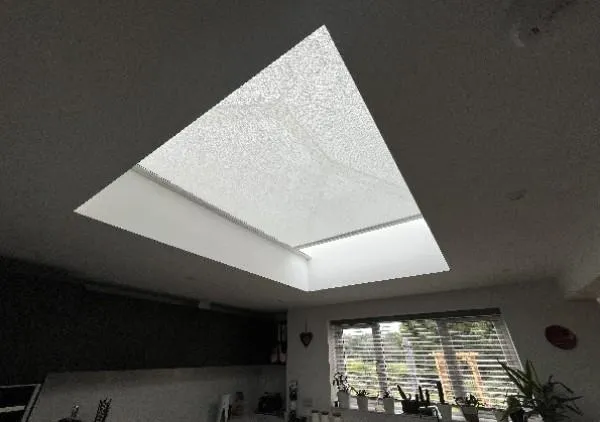
Best Value Electric Blind Fabrics
It’s one of the most common questions we get, and honestly, one of the most important. When it comes to specialist blind fabrics, what does 'good value' really mean?
The answer might not be what you think, but getting it right can be the difference between a room you love and one you have to abandon every time the sun comes out. To get you started, here are the key things to keep in mind.
Key Takeaways:
True value is defined by performance (how well a fabric solves heat or glare), not just its pattern or low price.
The cost of a fabric is driven by its hidden technology, like solar reflectance and UV protection, not designer names.
Cheaper fabrics provide basic privacy but won't solve significant heat or glare problems, often leading to disappointment and the need to 'buy twice'.
Think of performance fabric as insurance for your other investments, like flooring and furniture, which are damaged by UV rays.
The Great Fabric Divide: Performance vs. Pattern
Have you invested so much time and effort into a beautiful glass extension, only to find it’s the one room nobody wants to be in on a sunny day?
It's a story I've heard so many times, and the frustration is completely understandable.
As you search for a solution, it’s easy to get lost in a world of colours and textures. But the reality is, blind fabrics fall into two main camps. Think of it like this: on one side, you have fabrics designed primarily for aesthetics – the look and feel. On the other, you have technical fabrics, engineered from the ground up to solve a specific problem, like heat, glare or UV damage.
Before we talk about the cost of the fabric, let’s talk about the ‘cost’ of an unusable dining table or a sofa you can't sit on. I believe true value isn't found in a low upfront price; it's found in reclaiming the part of your home you’ve lost to discomfort.
What Drives Fabric Costs Up? The Technology You Can't See
It’s a common assumption that expensive fabrics are just about designer names. In my experience, the cost is in the science.
You're not just paying for a colour; you're investing in the technology woven into the very fibres of the material. These are the factors that really make a difference:
High Solar Reflectance: Some fabrics are designed to act like a mirror for heat, bouncing it back outside before it can turn your room into a greenhouse. This is a highly-engineered quality, often involving a fine, metallised backing that you don't even see.
Specialised Weaves: Technical fabrics can be woven to a precise 'openness' that cuts that blinding glare but still allows you to enjoy your garden view. It’s like putting a high-quality pair of sunglasses on your window, managing the light without leaving you in a dark box.
UV Inhibitors: This is so important. Premium fabrics contain properties that block the invisible UV rays that relentlessly fade expensive floors, sofas, and artwork. This isn't just about the blind; it's about protection.
Dimensional Stability: For large blinds on roof lanterns or bi-folds, this is essential. These fabrics are engineered not to sag or stretch under constant tension, which is key for achieving that flawless, taut finish that looks like part of the ceiling.
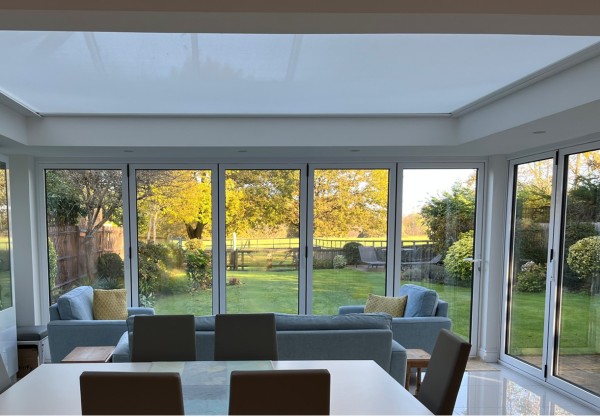
What Makes Some Fabrics More Affordable? Understanding the Trade-Offs
More affordable fabrics, typically 100% polyester, absolutely have their place. They do a perfectly good job of providing basic privacy and adding a splash of colour, and for many standard windows, they are a perfectly sensible choice.
But it's just as important to be honest about what they don't do. They simply don't have the technology to manage significant heat gain or eliminate severe glare.
If your main problem is a room that feels like a greenhouse, a standard fabric won't solve it. This is the crucial trade-off: a lower initial cost for much lower performance.
The Hidden Cost of 'Cheap': A Cautionary Tale
You will always find cheaper options out there. But often, that lower price comes from using basic materials with no performance technology, leading to a classic problem we see all the time: buying twice.
You invest in a low-cost solution, only to find a year down the line that the room is still unusable, and you're back at square one.
The 'Insurance Policy' Analogy
Let me share an idea that I find really helps people see this clearly. Imagine you've just spent a fortune on a beautiful Scandinavian wood floor for your new extension. A ray of sun hits it through your glass roof, and you realise it's not just light; it's an agent of destruction.
A cheap blind fabric won't stop the invisible UV rays that will slowly and silently fade and damage that beautiful floor. Suddenly, the 'value' conversation changes entirely, doesn't it? A performance fabric stops being just another expense; it becomes essential insurance for your other, much larger investments.
This is the very heart of our S.H.A.D.E. principle—thinking about shading not as an accessory, but as a fundamental part of protecting your home's comfort and value.
What Should I Expect to Invest in a Performance Fabric Solution?
To be completely open, we specialise in high-performance fabrics. That’s because people usually come to us when they have a significant comfort problem to solve in a room with a lot of glass.
Because of this, our solutions naturally sit in the premium category.
For a typical electric roof blind project, which can be an investment of up to £5,500, a large part of that cost is for the high-performance fabric and the specialist motor and tensioning system needed to make it work flawlessly.
The fabric isn't an afterthought; it’s the engine of the entire solution.

Three Simple Steps to Choosing the Right Fabric for You
Feeling more prepared? Here’s a simple process to follow to make sure you get it right.
Start with Your Biggest Problem: First, be really clear on your number one priority. Is it the unbearable heat? The blinding glare that makes watching television impossible? The worry about your new furniture fading? Or is it simply about night-time privacy? Your main frustration is the best signpost to the right type of performance fabric.
Ask for the Proof, Not Just the Pattern: When you speak to a supplier, don't just get lost in the sample books. Ask them for the performance data. Ask, "What is the solar reflectance of this fabric?" or "What's the openness factor?". A true specialist will have these answers and will be happy to explain what they mean for your home.
Weigh the True Value: Finally, weigh the cost of the fabric against the cost of the problem itself. What is it worth to you to get your dining room back for family meals? What's the value of protecting your new sofa from fading? That, right there, is the real calculation.
How to Make a Confident Choice
So, how do you make that final decision with confidence? It comes down to asking yourself a couple of honest questions.
What is the real cost you're trying to avoid? Is it the price of the blinds, or is it the ongoing cost of having a beautiful room that you can't actually use?
And what is the real value you're looking for? Is it a fabric that just covers the glass, or is it the daily comfort of a home where every single room is a pleasure to be in, all year round?
If you're facing a challenge with heat or glare and want to talk through the fabric options that could genuinely solve it, our specialists are here for a friendly, no-pressure chat.
Give us a call on 01256 345580 to explore the possibilities.
To see how these fabrics have completely transformed homes like yours, take a look at some of our customer stories.
